
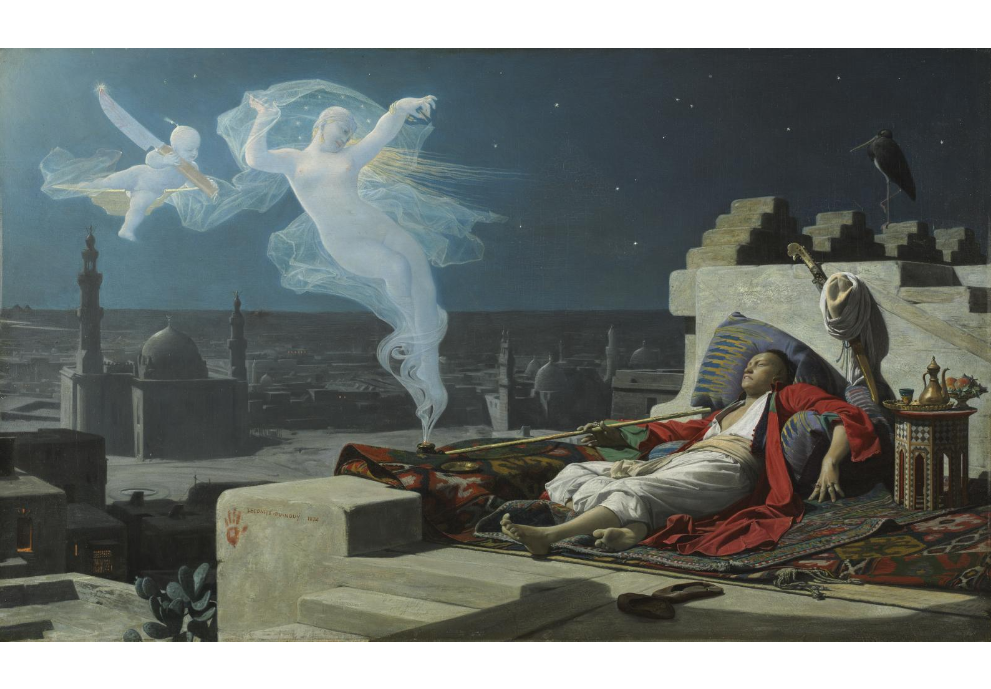
“A Eunuch’s Dream,” 1874 by Jean Lecomte du Nouÿ
Wherever you are, hello, this is Camusgaard. After the existential tone of my last post, I thought I would make things lighter by talking about everyone’s favorite: eunuchs!
The following short essay is an assignment that I wrote for a class dedicated to the history of racism with a focus on the Middle East and Northern Africa. Among other questions, the point of the class was to ponder where the idea of “racism” comes from and the many ways that racism can operate and be understood. At its most abstract, this anthropology course was a semester-long seminar in historical discussion of social differences.
So naturally, when given the chance to write about whatever I wanted for my racism class, I chose to write about eunuchs. I mostly wanted to be snarky, but I think I made an argument well within the lines of understanding social differences in history. It was hilarious to me that my professor had to seriously consider and grade this work.
For your consideration, I have included that untitled essay below and made only minimal stylistic changes since based on my professor’s feedback. Brief pitfalls of my argument and explanations of my points will be included in the form of footnotes. Anyways, enjoy!
ANTH 331
07 October 2022
Short Assignment #2
Hippocrates and Harriet Martineau each mention eunuchs in their respective works “Airs, Waters, and Places” and “Eastern Life, Present and Past”.1 I argue both authors discuss eunuchs because of the challenge they pose to binary conceptions of gender and social classification. Both authors view eunuchs in other cultures through a dismissive and essentialist lens. Because of eunuchs’ lack of male genitalia, Hippocrates and Martineau cast Scythian and Egyptian eunuchs alike as failed men rather than as carriers of a unique and potentially advantageous social role.
Hippocrates and Martineau explain the presence of eunuchs in society differently, though they reach similar conclusions about them. As Hippocrates explains in Part 22 of “Airs, Waters, and Places,” the eunuchs in Scythian society are men who become sexually impotent after years of horseback riding (400 BCE). Believing their condition is divinely ordained, however, Scythian men embrace their genital dysfunction and conflate it with femininity, choosing to dress and speak like women (Hippocrates 400 BCE). Other Scythians even venerate these eunuchs, hoping to avoid impotence themselves (Hippocrates 400 BCE).
Martineau, on the other hand, describes Egyptian eunuchs as the result of social practice rather than divine intervention or horse riding. Polygamy was dominant within the ruling class of 19th-century Egypt, and eunuchs were created to entertain and protect the wives of wealthy men (Martineau 1848, 40). Among other duties, eunuchs often served as a link between their master, the wives in their care, and the outside world (Martineau 1848, 41). In compensation, eunuchs were “indulged in regard to dress, personal liberty, and the possession of [domestic, military, political] office” (Martineau 1848, 40). Though Egyptian eunuchs did not completely “become women” as in the Scythian case, they were expected through the course of their work to befriend and entertain women while being denied the masculine experience of heading a household themselves (Martineau 1848, 41).
To Martineau, Egyptian eunuchs’ inability to “fulfill” masculinity by running their own household forms part of her argument against the practice of polygamy. Viewing eunuchs as social actors without agency or “failed” men denies the social benefit that becoming a eunuch carries in both Egyptian and Scythian society, however. In fact, for Scythian men that become impotent or lower-class Christians in Egyptian society2 looking for better material conditions (Martineau 1848, 40), becoming a eunuch is less of an aberration of manhood than a costly bargain for social mobility. By viewing eunuchs as “what they were” – the two authors each concerned with whether these people have a functional penis – rather than what they are – a remade, distinct social actor – Hippocrates and Martineau undervalue3 the importance of eunuchs to these societies.
While I am not making the case that more men should become eunuchs, it is important to note the social context of the eunuchs in question. To the Scythians, a man who becomes impotent becomes a locus of divine will to his peers, and is subsequently venerated. Though eunuchs lose the ability to perform a “man’s job” of procreating, and are easily discovered as “effeminates” taking on feminine characteristics, the loss of one’s penis4 opens a new opportunity as a critical link in a socially-accepted causal chain between angering the gods and becoming impotent. In other words, Scythian eunuchs do more than a man could to “sponge” the misfortune of their peers.5 Meanwhile, the Egyptians who become eunuchs are able to enjoy extreme material benefits on account of their service to the ruling class. Once again, a man has been transformed into somebody who does what a man cannot – in this case, closely interacting and bonding with women in a society where such relationships are ordinarily forbidden outside of marriage. To harem wives, eunuchs become a playmate, protector, and even an emotional lover in some cases (Martineau 1848, 41). By discussing eunuchs in terms of what they were and what they can no longer do, Hippocrates and Martineau gloss over the notable social benefit carried with losing one’s penis in Scythia and Egypt. Neither man nor woman,6 eunuchs frustrate these authors’ attempts to project gender binaries on other cultures and force us to caveat Hippocrates’ and Martineau’s authority on these societies.7
The Martineau citations I make use page numbers from an edited volume of women travel writers (Shirley Foster and Sarah Mills’ “Anthology of Women’s Travel Writing,” published 2002), but you can also find Martineau’s quotations in the source I have linked. The section I read for class was titled “The Hareem” and begins with, “I saw two Hareems in the east…” on page 173.
Not all eunuchs in 19th-century Egypt were Christian, yet Christians were the “suppliers” or “producers” of eunuchs. It is also worth mentioning that Christians weren’t necessarily lower class.
“Misrepresenting eunuchs” may be a more appropriate word choice here.
Scythian eunuchs did not necessarily lose their penis.
The logic goes, “Thank God that the other guy ‘took the blow’ and was made a eunuch.”
My professor’s sense of Middle Eastern literature suggests that eunuchs were socially considered a type of man, yet it would be interesting to learn how eunuchs considered themselves.
Martineau has so little to actually say about eunuchs in her work (combined with a lack of knowledge and experience with eunuchs in this context) that working with her work this way is a little bit of a stretch. But hey, stretching these sources to be about anything other than race was part of the snark.